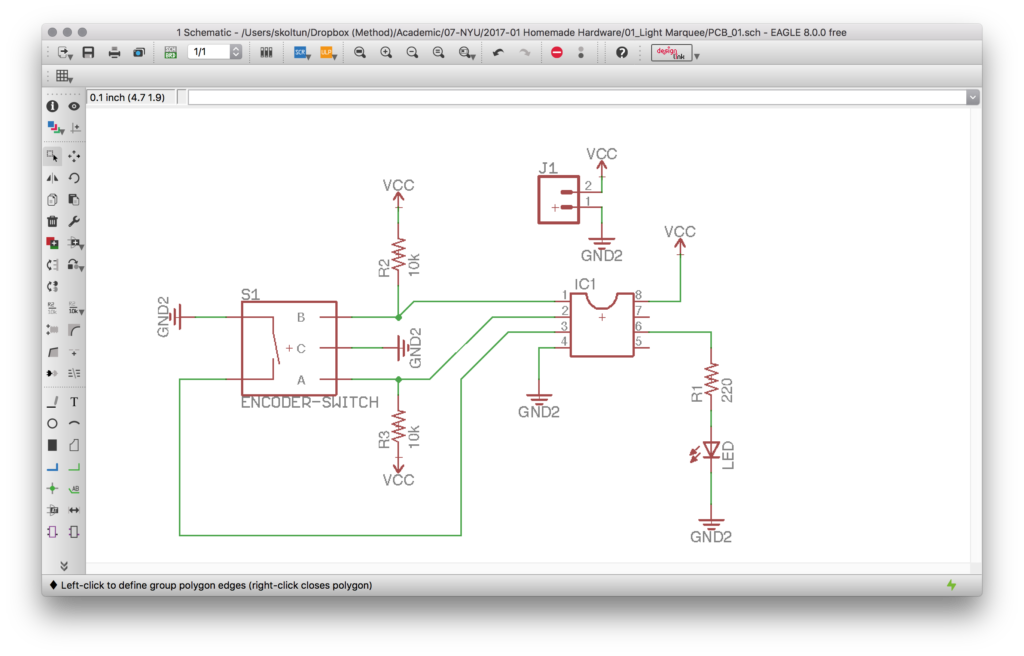
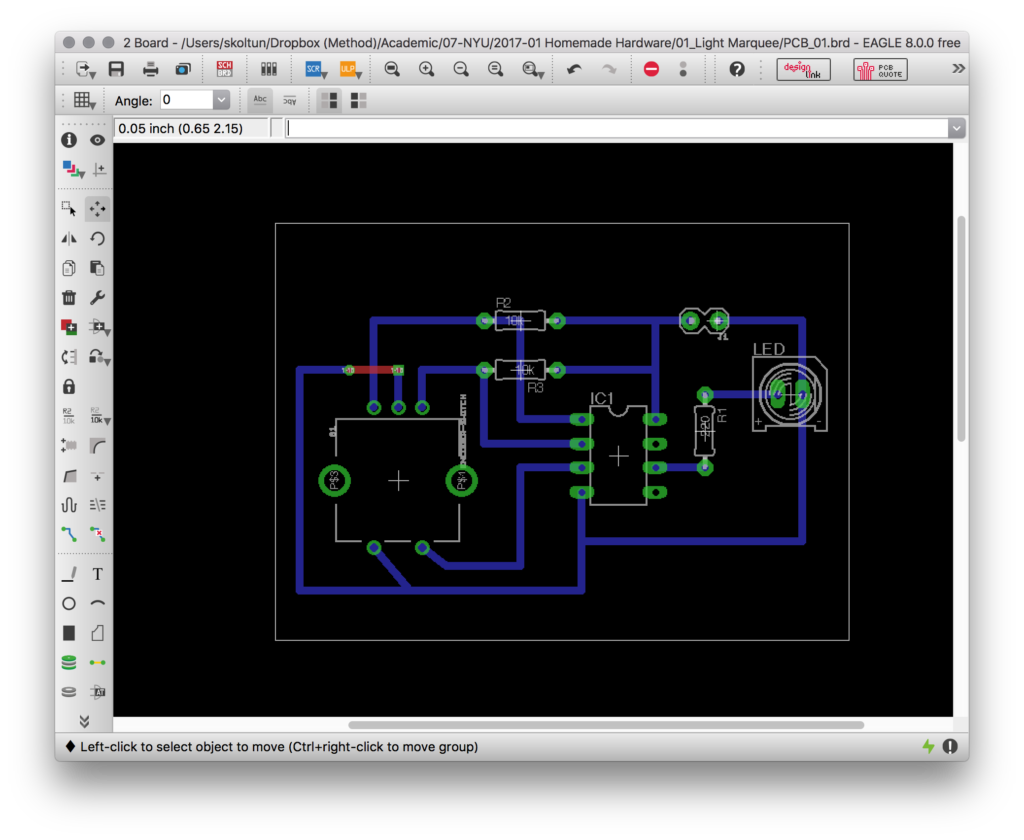
Building on the previous week’s progress of a breadboard circuit in which a rotary encoder controls an LED, the images below have translated said circuit into a board layout ready for milling.
Documenting thoughts and works in progress
Building on the previous week’s progress of a breadboard circuit in which a rotary encoder controls an LED, the images below have translated said circuit into a board layout ready for milling.
Verbose v. Concise
What does it mean to have many functions distributed over many controls as opposed to many functions concentrated into a single control?
The required functions are as follows:
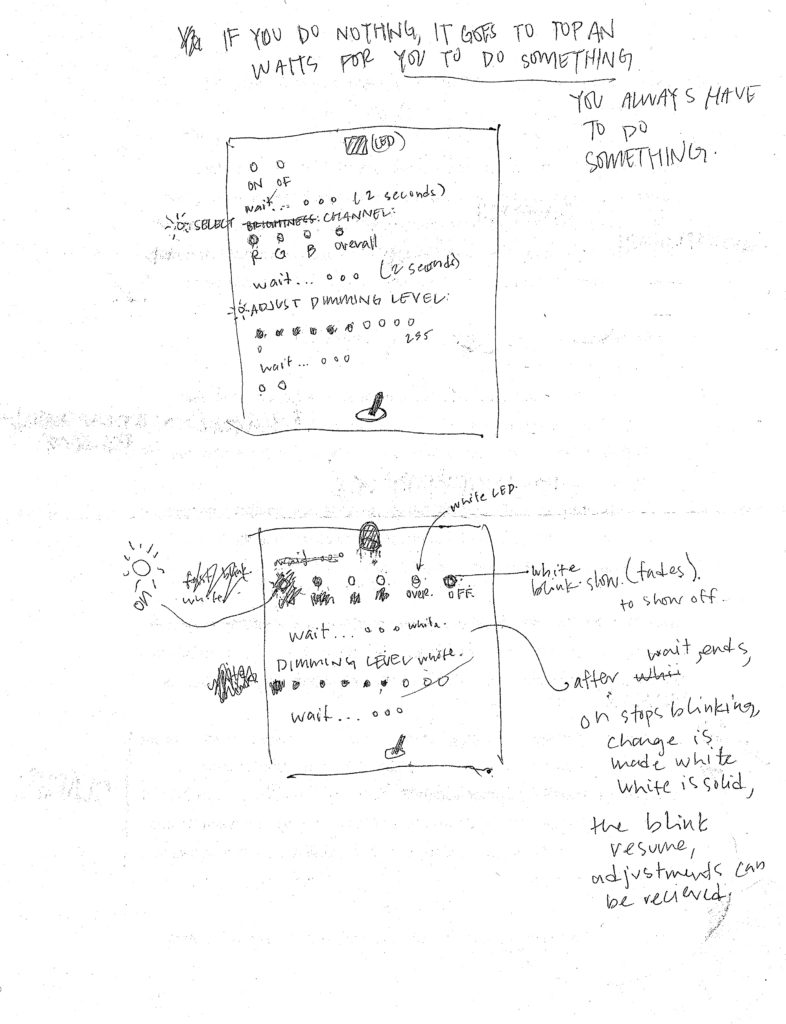
Below describes one controller (as pictured above), and one proposed controller (to be completed shortly, when my millions of switches arrive…)
In building out the Concise Controller with a single button, the LED functioned not only as the ‘lamp’ itself, but also as a visual indictor for each of the functional conditions. Blinking, fading and solid levels in combination with timed intervals are used to indicate, and then ‘lock in’, changes by the user.
However, how the light is turned off is still a particularly inelegant solution. As an option, it is within the same set of selections as individual color channels, and while the blinking rhythm is different, I anticipate this will be a point of confusion in practice. Alternatively, I’d like to implement an “off” switch by holding down the button for a set period of time and can occur at any point. I tried to get this functional in code, but it needs more work.
At Scale of the Controller v. Transistor
What prompted this idea of verbose and concise controllers was how states are tracked by sensors themselves.
Change is either ‘remembered’ as a constant state as with a toggle switch, or as a change in state as with a push button. (Maintained connection versus momentary connection.) Interestingly, sensors, like push buttons or force sensors, which indicate a change in state from the base condition do not have visual indicators themselves which show the change. (As opposed to a potentiometer or toggle switch in which the state or reading is reliant of the actual physical position — and thus visual indicator.)
How can either of these techniques promote a verbose or concise set of controls?
Conversely, a push button denotes a change in state, but isn’t physically changed once it is released; thus it relies more directly on code (physicality at another scale) to toggle between On and Off. A push button is a change, whereas the toggle switch is either on or off.
Similarly analog sensors:
Early Sketches
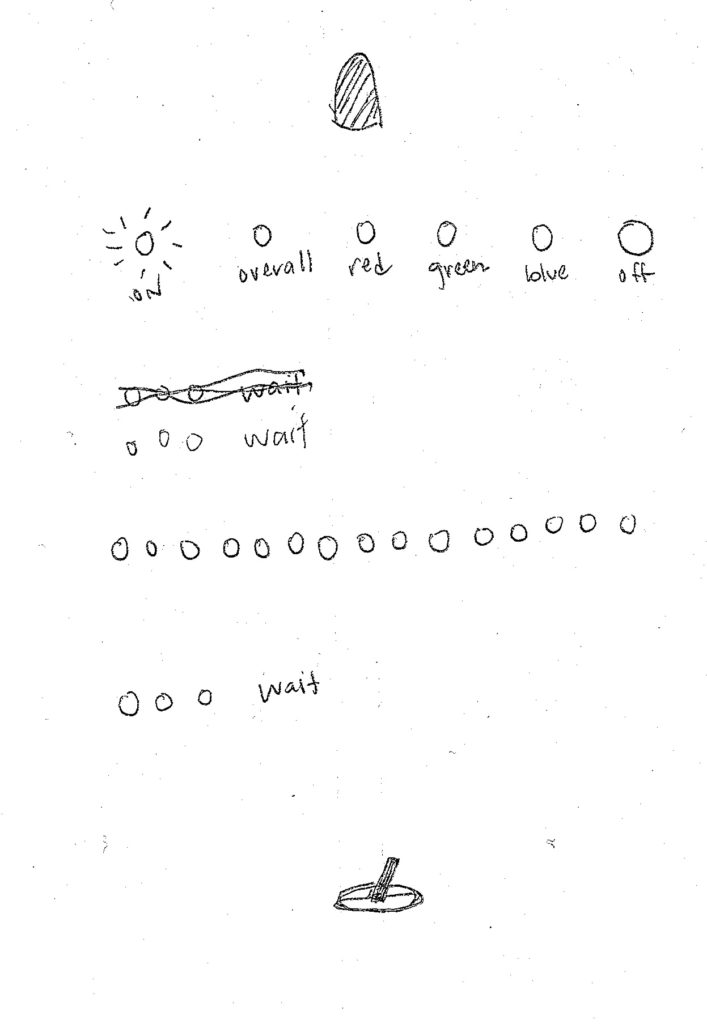
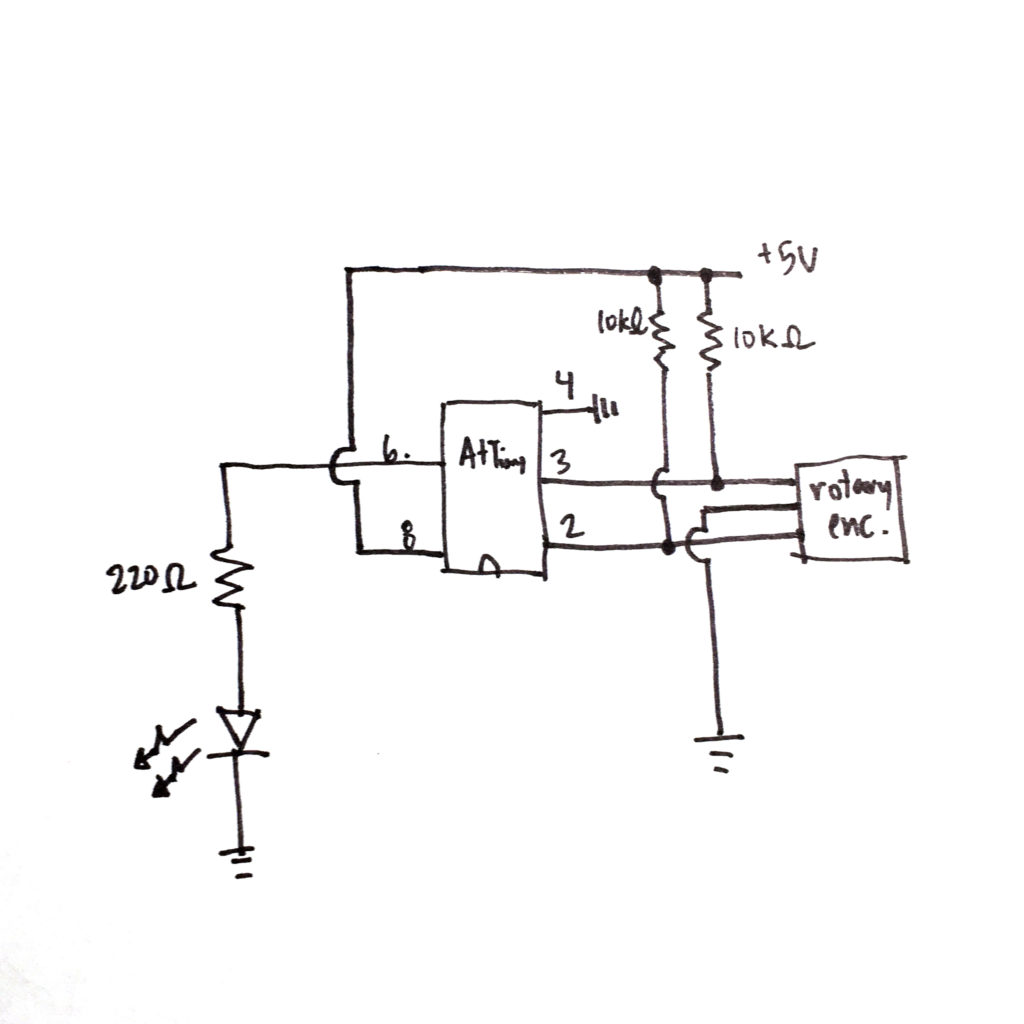
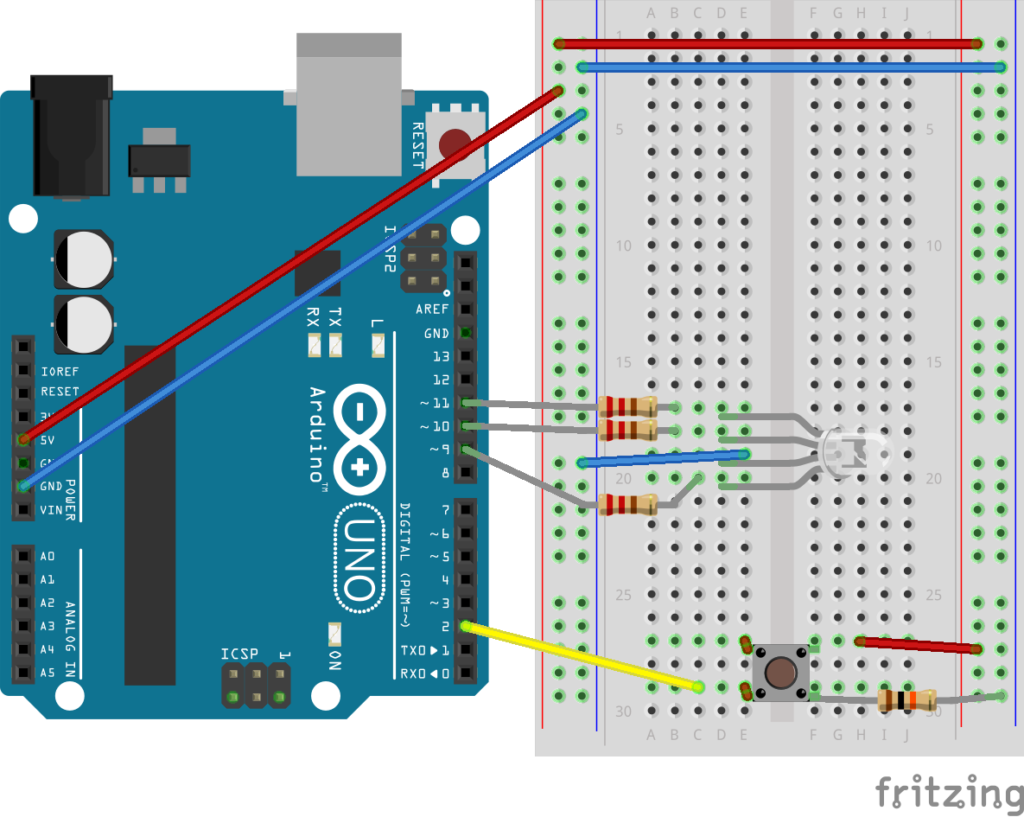
Using a rotary encoder, I’ve wired up a dimmable LED using an AtTiny. I haven’t worked with a rotary encoder before and quickly discovered it was nothing like a potentiometer besides for the fact that it turns. The rotary encoder also has a push button which I’d like to further incorporate and be able to toggle on and off the LED without going through the dimming process.
Only legible at sunrise, the body of text becomes increasingly illegible as the day proceeds.
Can’t see it? What time is it now? Come back tomorrow.
As We May Think, Vannevar Bush
Evident in Bush’s visionary essay is how our visions of the future are fundamentally constrained by our references of the present. Invention seems to be an incremental process in which one piece is slightly different than the proceeding, yet the changes accumulate and when compared over a large set of inventions, the changes can seem monumentous. For example, Bush proposed the memex, a piece of machinery as the library of collective information. The technology he describes builds on existing capabilities and anticipated advancements: an ordinary desk with multiple translucent screens for viewing of any number of microfilms. Each of these parts were either already developed or in the process of developing, but the notion of combining them and thus distributing collective information was revolutionary. Additionally, the navigation between many pieces of information becomes part of the memex itself, which Bush describes as trails.
Moreover, when numerous items have been thus joined together to form a trail, they can be reviewed in turn, rapidly or slowly, by deflecting a lever like that used for turning the pages of a book. It is exactly as though the physical items had been gathered together from widely separated sources and bound together to form a new book. It is more than this, for any item can be joined into numerous trails…
Thus he goes, building a trail of many items. Occasionally he inserts a comment of his own, either linking it into the main trail or joining it by a side trail to a particular item. When it becomes evident that the elastic properties of available materials had a great deal to do with the bow, he branches off on a side trail which takes him through textbooks on elasticity and tables of physical constants. He inserts a page of longhand analysis of his own. Thus he builds a trail of his interest through the maze of materials available to him.
Yet the idea of easily distrubting and accessing information is still constantly pursued today. Bush presents a tool for collective information distribution in the hopes of a collective knowledge. The distinction between information and knowledge is important as the network has largely enabled his goal of collective information. While information may be accessible, its accessibility does not guarantee its collective understanding or knowledge. Perhaps the next increment in this invention is not a technological advancement but human-being one? How do we intellectually, socially and culturally process all the information now made accessible? What does it mean for information to be accessible but not become knowledge?
Lastly, one last incomplete thought…Bush describes the memex as a means for outsourcing our memories:
He has built a civilization so complex that he needs to mechanize his records more fully if he is to push his experiment to its logical conclusion and not merely become bogged down part way there by overtaxing his limited memory.
But by not storing things in our memory, do we have to re-learn and re-identify information over and over again?